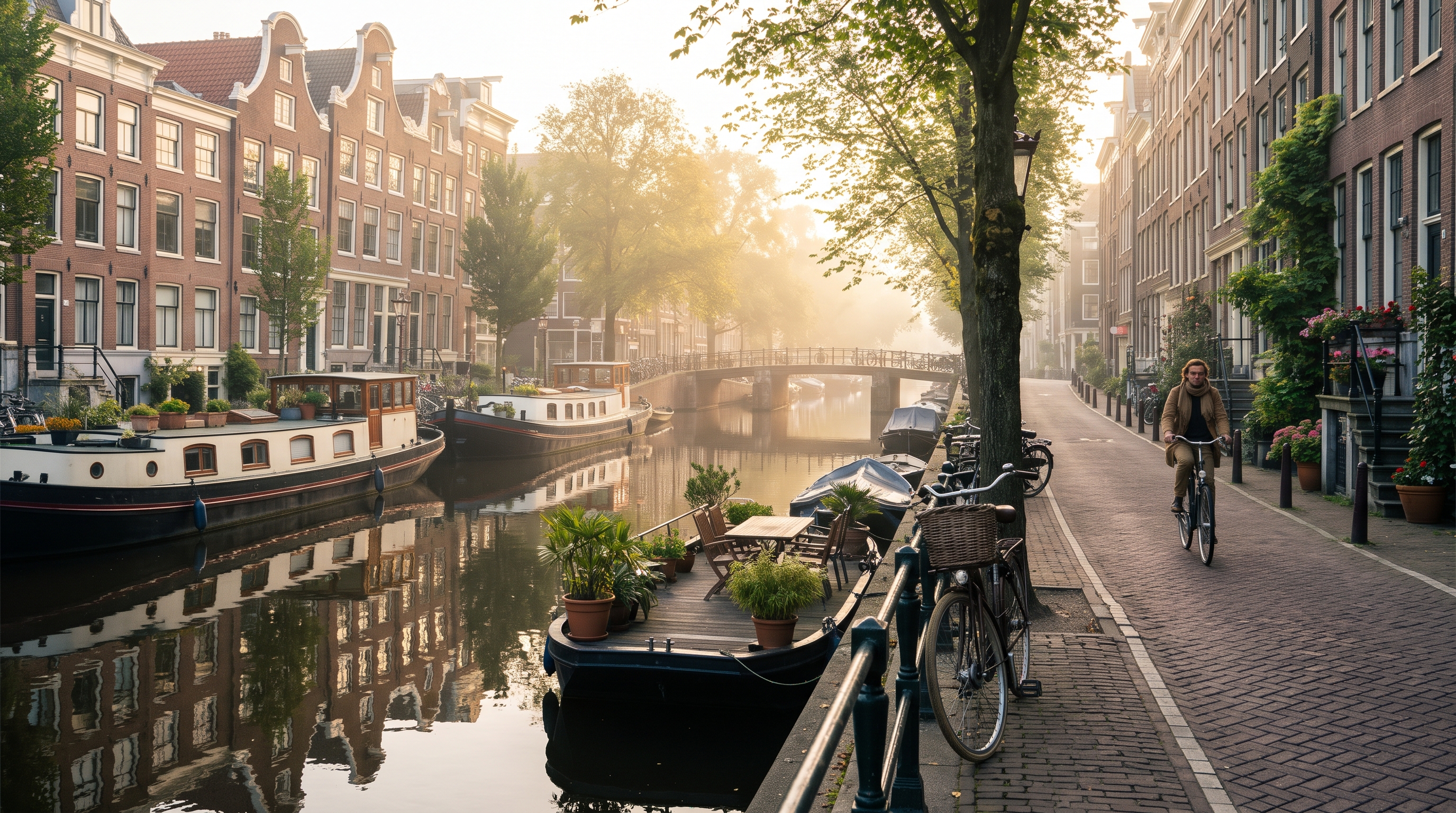
Before the commuter bells chime and tour boats cut through the reflections of 17th-century gables, Amsterdam exists in a state of suspended stillness. The morning mist hovers inches above the Prinsengracht, bicycle chains hum softly against wet stone, and the scent of damp brick and roasted chicory fills the autumn air.
Morning: Silent Grachten & Secret Hofjes
Set out just before 8:00 AM on foot through the narrow passages of the Jordaan district. Originally built as a working-class neighborhood during Amsterdam's Golden Age, today its tree-lined residential canals offer the city’s most meditative wandering.
"To experience Amsterdam intimately, leave the main arterial ring and let the narrow radial alleys dictate your cadence. The water absorbs the noise of the world if you listen closely."
Hidden behind modest wooden residential doors lie the city’s famous hofjes — inner courtyard almshouses funded by 17th-century merchants to house elder citizens. Many remain peaceful community sanctuaries:
- Hofje van Brienen (Prinsengracht 89–133): Step through the arched passageway into a quiet courtyard flanked by lime trees, clipped hedges, and silent brick residences preserved since 1804.
- Screaming Beans or Toki: Head toward Binnen Dommersstraat for a velvety flat white or Japanese-influenced filter roast served in minimalist Nordic-industrial interiors.
- Noordermarkt Organic Stalls: On select mornings, local cheese mongers, organic bakers, and antique print collectors gather under the shadow of the Noorderkerk.
Midday Route: The Architectural Western Islands (Westelijke Eilanden)
Rent a traditional steel-framed upright bicycle (omafiets) and ride northwest away from the Jordaan toward the three interconnected islands: Bickerseiland, Prinseneiland, and Realeneiland.
Connected by white wooden drawbridges and paved with weathered stones, these islands feel like an isolated maritime village frozen in time. Converted timber warehouses, shipwright lofts, and working artist studios face calm water where houseboats are adorned with potted ferns and solar panels.
Recommended Cycling Etiquette:
- Keep right, signal turns clearly with an outstretched arm, and maintain a relaxed, non-competitive pace.
- Dismount when crossing narrow wooden pedestrian bridges to respect residents and resting herons.
- Lock both the rear frame ring-lock and a heavy chain to fixed municipal bike stands.
Afternoon: Design on the Water & Floating Living
Amsterdam’s houseboats (woonboten) are not merely novel accommodations; they represent an ongoing evolution of waterbound urbanism and sustainable living.
Take an unhurried walk along the Brouwersgracht, widely considered the most harmonious canal in Europe, where former spice, beer, and grain warehouses have been repurposed into design sanctuaries:
- Woonboot Museum (Houseboat Museum): Step aboard a retrofitted 1914 sailing freighter on the Prinsengracht to see firsthand how space-saving joinery and floating mechanics function beneath the water line.
- Café de Dokter: Tucked into a pocket near Spui, Amsterdam’s smallest brown café (dating back to 1798) serves jenever and Trappist ales against a backdrop of antique medical oddities and soft jazz.
- Canal Steps at Sunset: Find a dry stone mooring ledge along the Bloemgracht as the golden hour turns the water to deep amber and boaters drift home under the bridges.
Slow Traveler’s Note: Floating Home Etiquette
Amsterdam's houseboats are private residences. When walking or cycling past, avoid peering directly into windows or stepping onto private floating decks. Admire the maritime architecture and floating herb gardens from the canal banks.